Haydn's Creation played by the Boston Symphony Orchestra
I heard Joseph Haydn’s The Creation played by the Boston Symphony Orchestra conducted by Philippe Jordan.
Last night, November 5, 2026, I attended a concert of the Boston Symphony Orchestra led by guest conductor Philippe Jordan at Symphony Hall in Boston, Massachusetts. The BSO and the Tanglewood Festival Chorus performed the oratorio The Creation (Die Schöpfung) by the Austrian composer Joseph Haydn.
The soloists were Louise Alder (soprano), Bogdan Volkov (tenor), and David Steffens (bass-baritone). The enormous Tanglewood Festival Chorus was prepared by BSO Director of Choruses Jean-Sébastien Vallée. Jan Swafford wrote the informative and enlightening program notes.
I had never heard The Creation before, and when I learned from the Wikipedia article that the piece is “considered by many to be [Haydn’s] masterpiece,” I decided I should hear it.
The music was marvelous, and the soloists, chorus, orchestra, and conductor were excellent. The libretto, sung in German with English supertitles, covers the creation story from Genesis from the very beginning through the creation of Adam and Eve and their delight with the new world. (There was only the slightest hint that things might go wrong later.) Haydn’s music contains a number of surprises and delights, especially when the choir sings, “Let there be light!”
According to the program, the last performance of this work by the BSO took place in 1998. I partly understand why this oratorio is infrequently performed. This is a long work: Parts I and II required one hour twenty minutes, after which there was an intermission for twenty minutes, and Part III lasted another thirty minutes. The piece requires three soloists and a full chorus, but the orchestra itself was not large (only six cellos and four basses). There were two fortepianos (made by R. J. Regier, Freeport, Maine) on stage, one played by Philippe Jordan during the recitatives. I would like to hear The Creation again, but if I have to wait twenty-eight years for the next performance, I will no longer be alive (I would have to live to be a hundred years old).
Next week, as a complement to this concert, Eric Jacobsen conducts the world premiere of Osvaldo Golijov’s Creation, “an evening-length BSO commission that includes soloists from diverse genres, two choruses, and original animation and projections.”
Seating in Symphony Hall
I am experimenting with different seating locations during this season at Symphony Hall. For the first two concerts I attended this fall, I bought very expensive seats on the main floor close to the stage so I could watch the soloists. For this concert, I chose seat A25 in the second balcony on the left side of Symphony Hall. The view was partially blocked by the safety railing.
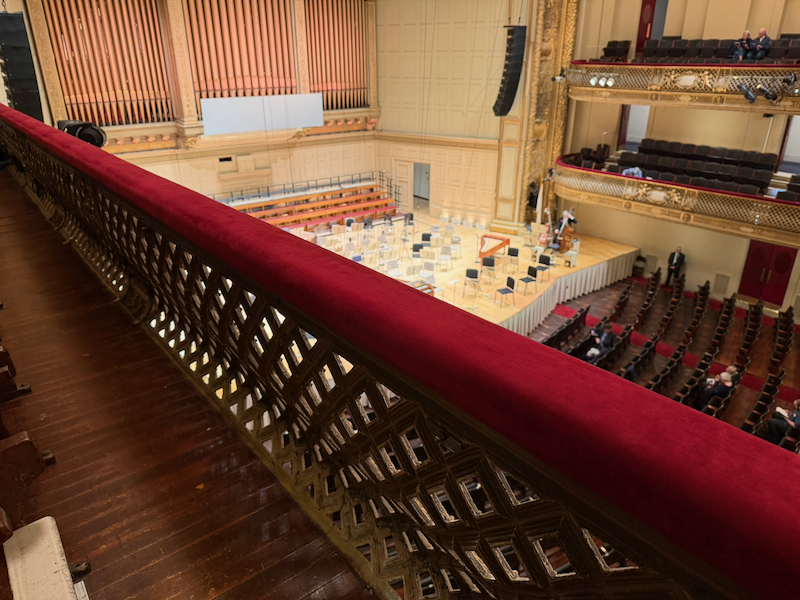 Seated View from Seat A25 in the Second Balcony Left Side
With some leaning, I could view the entire stage. All of my neighbors were leaning at times to see.
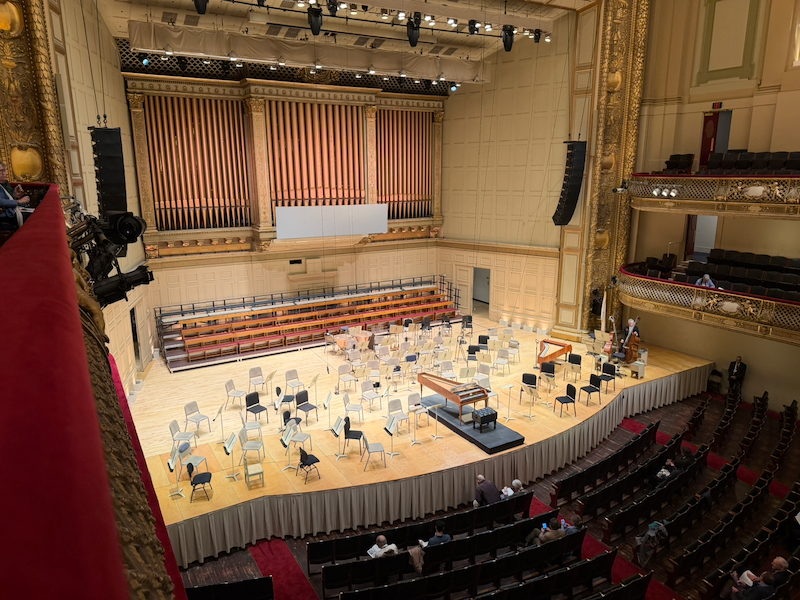 Leaning View from Seat A25 in the Second Balcony Left Side
Since I had arrived thirty minutes before the concert and most seats were as yet unoccupied, I tested sitting in the second row, row B, which is up two steps from row A, but the view was the same.
The sound was excellent; my experience is that the sound is good in any seat in the hall. I think sitting in the second balcony is perfectly fine when I’m more interested in hearing than seeing a concert.